Kytos Observatory · quantum workstream
For 40 years, KRAS was called undruggable.
The pocket that finally cracked it wasn't at the active site — it was allosteric, encoded in the protein's contact topology. We put that topology onto a real quantum processor and measured what survives.
(KRAS 0.84× · myosin 1.01×)
(Bloch cosine)
The experiment
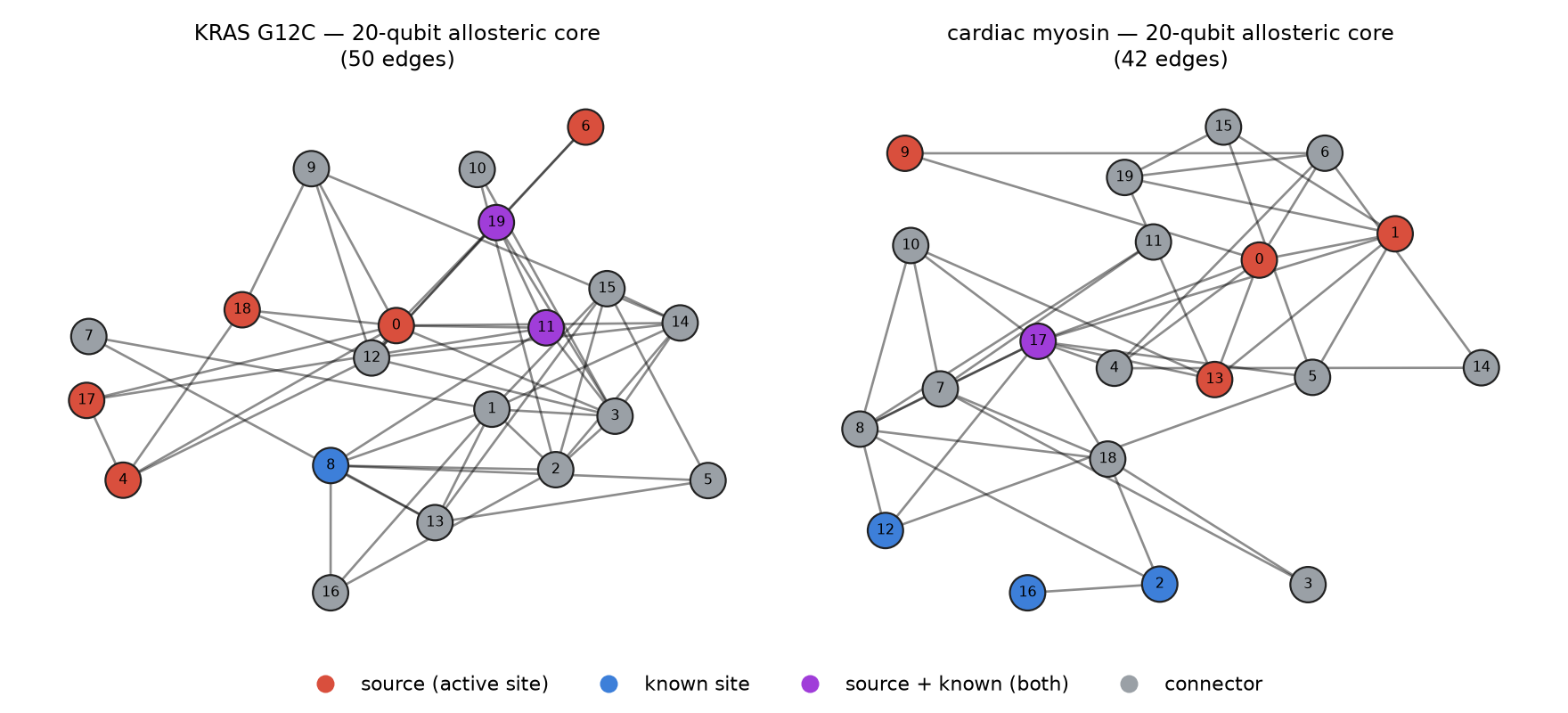
Protein contact graphs — which residues touch which —
carry the topology that allosteric drug sites live in. We take each
target's coarse-grained contact graph, keep the biologically meaningful
core (catalytic "source" supernodes, the known allosteric pocket, and
the strongest couplings between them), and submit it to Moth's
graph-v1 engine as a 20-qubit coupling map.
metrics/graphs/.Watch it decohere
Each coupling map ran twice: emu (Moth's
Aer emulator) and qpu (IBM ibm_fez, 1024
shots, full two-qubit tomography on every graph edge). Edge thickness
is the measured correlation strength — flip the switch and watch what
real hardware does to it.
Hear it decohere
The same measurement, rendered as sound. Each of the 50 graph edges plays one note; pitch is the measured correlation strength, timing is fixed by edge order. Play them in turn — the melodies differ exactly where the hardware redistributed the correlations.
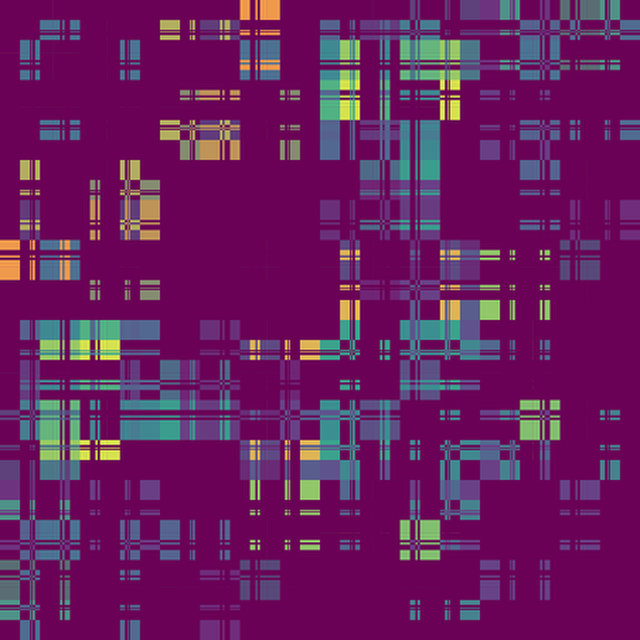
telablur engine — decoherence, painted by the same class
of machine that produced it.What the hardware did to it
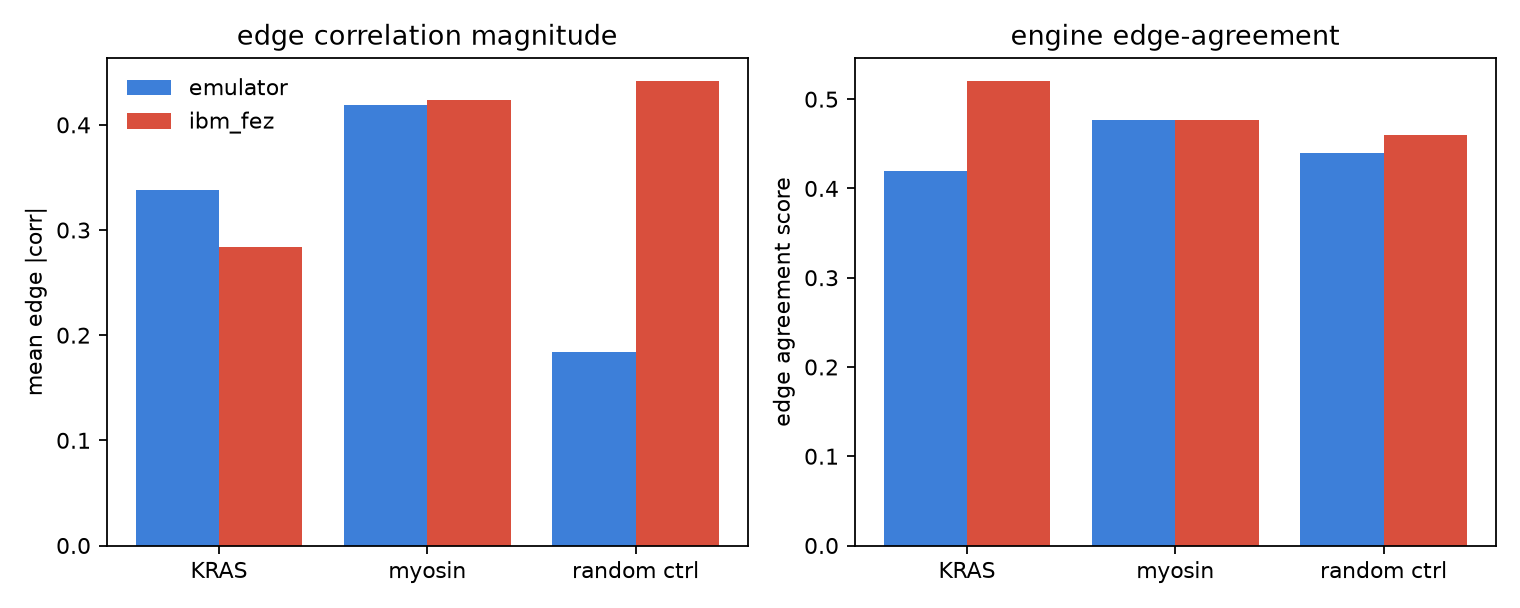
The numbers behind the widget — three findings, all verifiable against the raw job receipts below.
- Two-qubit correlation MAGNITUDES survive real hardware: qpu/emu ratios 0.84 (KRAS) and 1.01 (myosin). Edge-agreement scores are comparable or slightly higher on hardware.
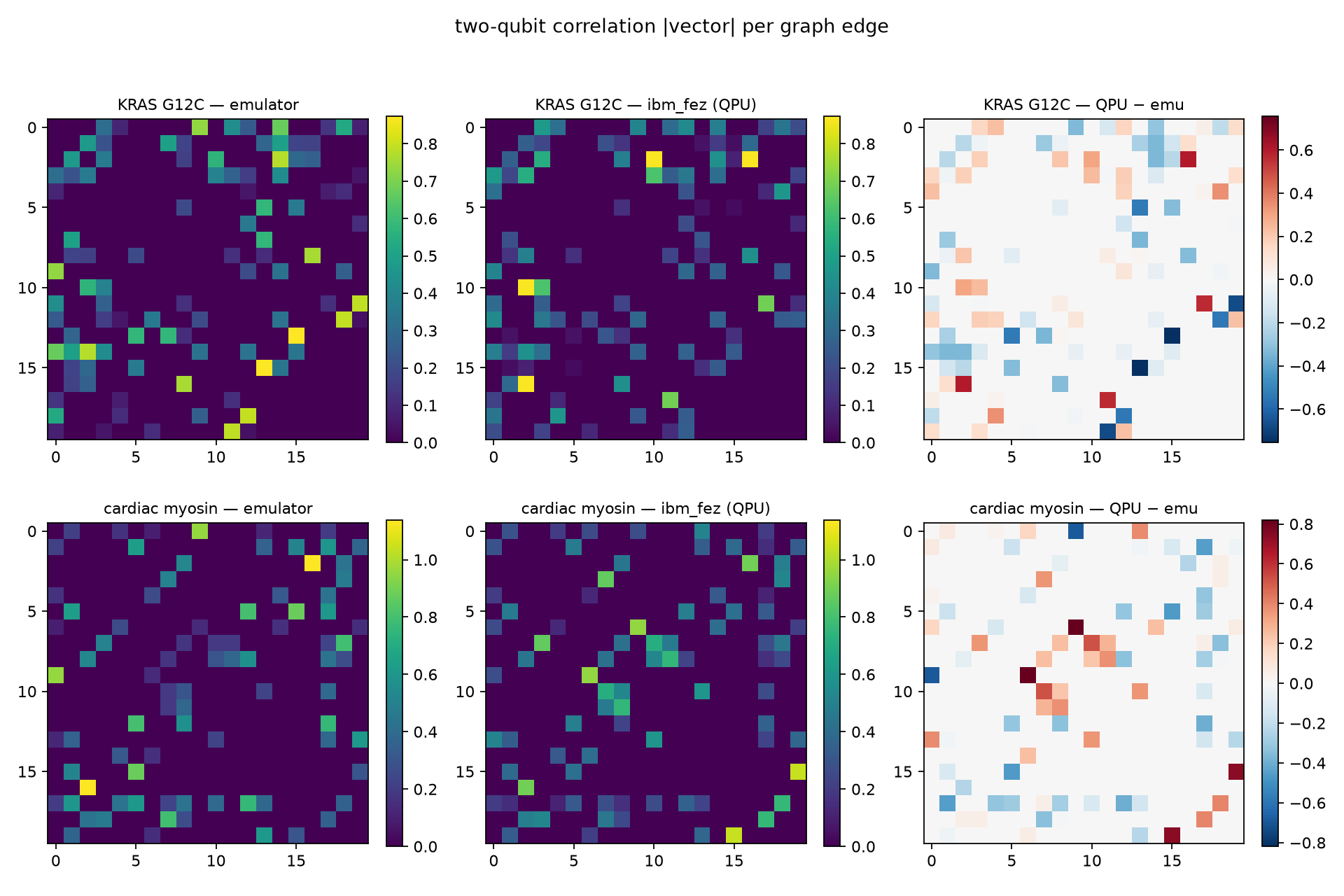
- Per-qubit Bloch-vector DIRECTIONS decorrelate between emu and qpu (median cosines -0.01, -0.27) - the dominant decoherence signature is directional scrambling, not magnitude loss.
- Random control (degree-matched 20-node/50-edge graph, ibm_fez db1d1h2vog1s73fhvp00): emulator edge-corr 0.184 vs KRAS 0.338 / myosin 0.419 - real topology is ~2x more correlated in emulation. On hardware the separation washes out (control qpu 0.441 vs KRAS 0.284): topology-specific fine structure is the first casualty of NISQ noise.
Technical detail — what the engine actually prepared
- The engine's prepared state is NOT a pure graph state (single-qubit |r| up to 1.0 vs 0 for a graph state); emu mode also deviates from the exact CZ-product baseline (metrics/graphs/*_exact.json). Interpretation is 'Moth correlated-state protocol driven by our protein topology', not graph-state fidelity.
- Role-level decomposition (source / known-site / connector edges) is inconsistent across targets and underpowered (n=5-6 known edges) - reported as noise, not signal.
- KRAS role means (qpu): source 0.305 / sourceknown 0.253 / connector 0.295 / known 0.237. Myosin: source 0.414 / sourceknown 0.281 / known 0.509 / connector 0.499.
Full tomography: correlation matrices + Bloch vectors
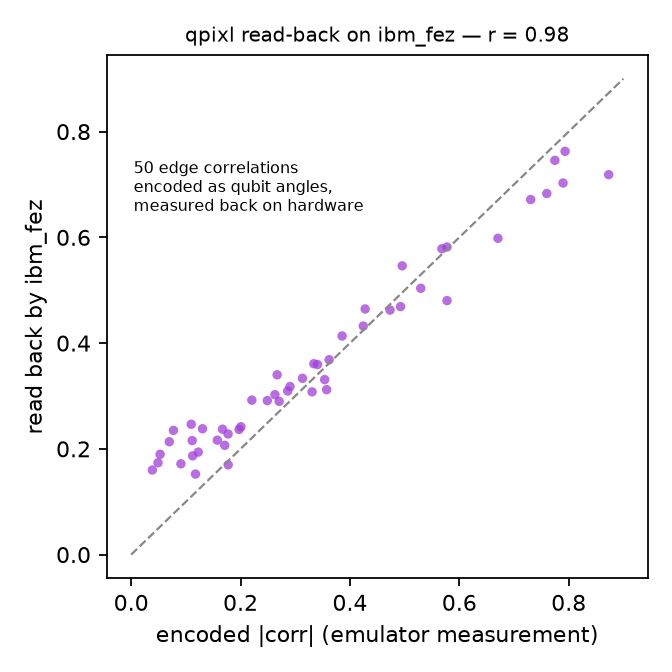
qpixl and
read back on ibm_fez — Pearson 0.98, mean error 0.057.
The values survive the machine; the directional structure is what's
lost.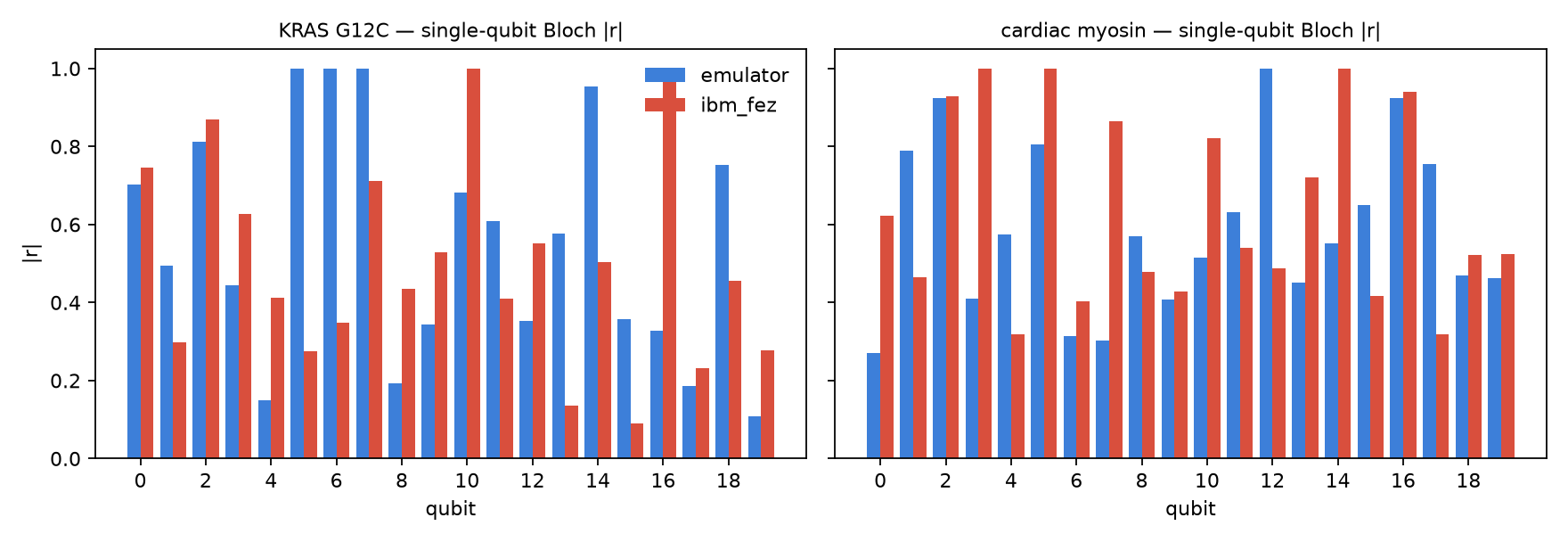
Receipts
Every claim on this page resolves to a submitted job. Each job ID links to the raw engine response committed in the repository — the file itself carries the ID, so the link is the verification.
| run | moth job (qpu) | moth job (emu) | IBM job |
|---|---|---|---|
| KRAS G12C | 252b239d-30c6-4400-bf45-7f78002993a6 |
21950e34-b55c-4f54-9fdb-be42eaa36ae9 |
db1crfrid5ic73eqvk1g |
| cardiac myosin | 54b278da-eb53-416b-bae7-f92f14b15769 |
f3629ed6-b52a-4b4e-9582-7c0fd567b14c |
db1cssjid5ic73eqvlc0 |
| random control | 6445e00e-c282-4aa3-87ea-a156a372274f |
f097e67a-3905-449b-b152-d44439ff76f9 |
db1d1h2vog1s73fhvp00 |
| correlation read-back qpixl-v1 |
1260e041-28c1-45c3-b224-96755f65130b |
— | db1e6o6egvvc73bhgtu0 |
How to verify independently
With any Moth API key, the platform replays the record server-side:
curl -H "Authorization: Bearer $MOTH_API_KEY" \
  https://api.mothquantum.com/api/v1/jobs/252b239d-30c6-4400-bf45-7f78002993a6/status
KRAS G12C: 20 nodes / 50 edges extracted from the 32-supernode coarse graph (GTP-site sources + Switch-II/Sotorasib known-site supernodes + strongest couplings).
cardiac myosin: 20 nodes / 42 edges extracted from the 56-supernode coarse graph (source + known-site supernodes + strongest couplings).
The record behind the run
c008 is the latest step of the Cleveland Clinic / GQAI quantum-allostery workstream — the same publish-everything discipline as the Virtual Cell Challenge runs on this site.
Honest caveats
What this page does not claim.
- graph-v1 internals are Moth's black box; the coupling_map parameterizes their protocol, circuit not exposed.
- emu vs qpu disagreement cannot be attributed purely to hardware noise without knowing the emu model.
- No claim is made that hardware correlations recover the known allosteric site; the CTQW ranking analysis (c002-c007) remains the biological method - this run supplies the hardware receipt + decoherence characterization.
- Pre-declared significance gate from the GQAI workstream remains unmet; nothing here changes that.
Artifacts
Code, graphs, request payloads, raw engine results,
analysis, and the reproduction scripts live in the repository:
experiments/cleveland/c008-moth-qpu-tomography/.
The classical+CTQW allostery pipeline upstream is
src/cleveland/.